




Stone Fabrication Guide
20mm vs 40mm Stone Edge Profiles: What Is the Difference?
The edge profile may be a small part of a countertop, but it strongly affects how thick, modern, soft or decorative the finished stone appears.
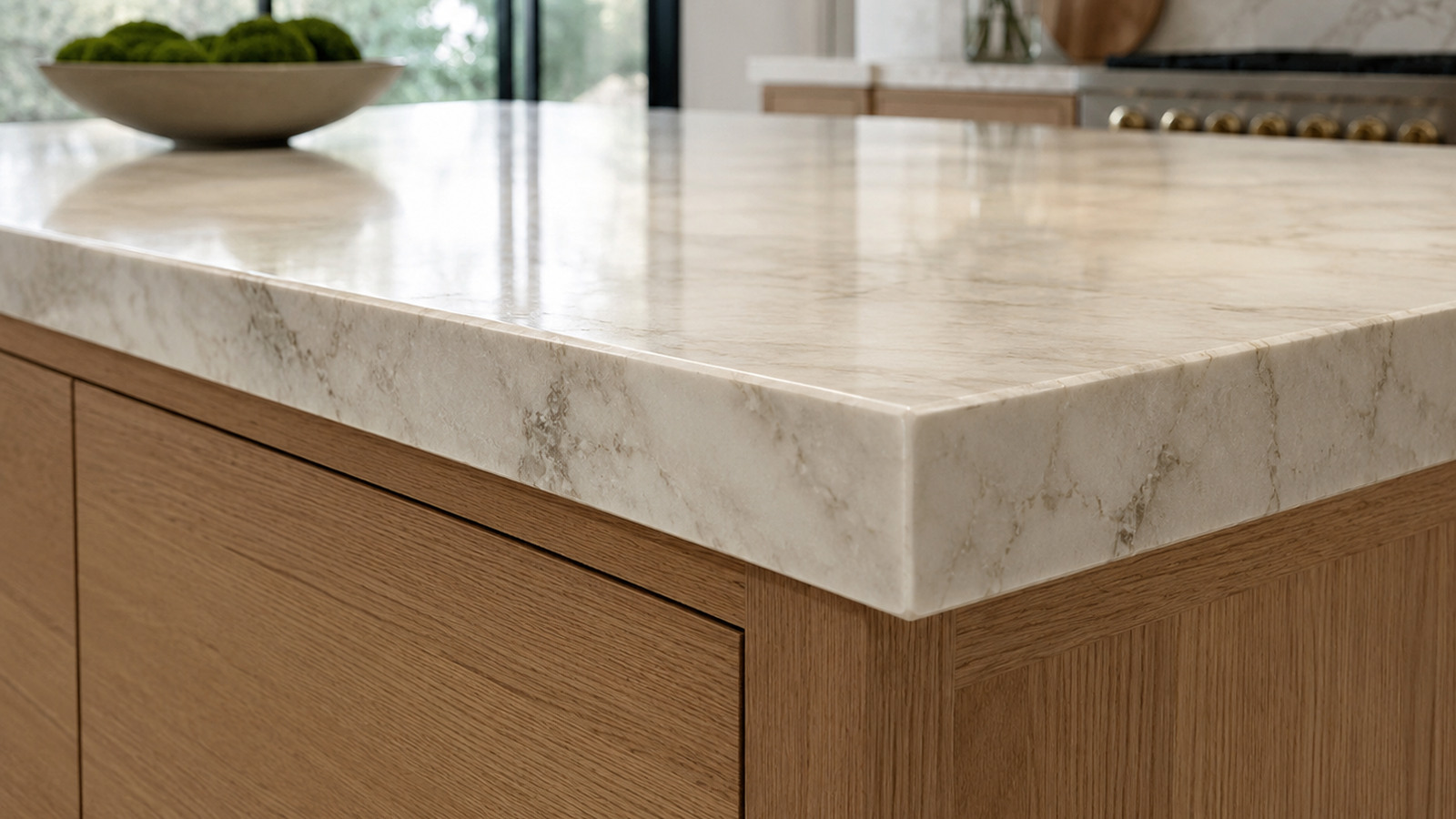 The edge profile affects the visual thickness, style and practical performance of a stone countertop.
When choosing stone for a kitchen countertop, bathroom vanity or reception desk, most attention is usually given to the material, colour and surface finish. However, the edge profile also has a major influence on the final result.
The same slab can look slim and contemporary with a simple 20mm edge, or heavier and more architectural with a built-up 40mm edge. The profile also affects how comfortable the edge feels, how visible the fabrication joints are and how well the countertop matches the scale of the cabinets below.
The comparison below shows two common categories: standard profiles formed directly from a 20mm slab and built-up profiles designed to create a 40mm finished appearance.
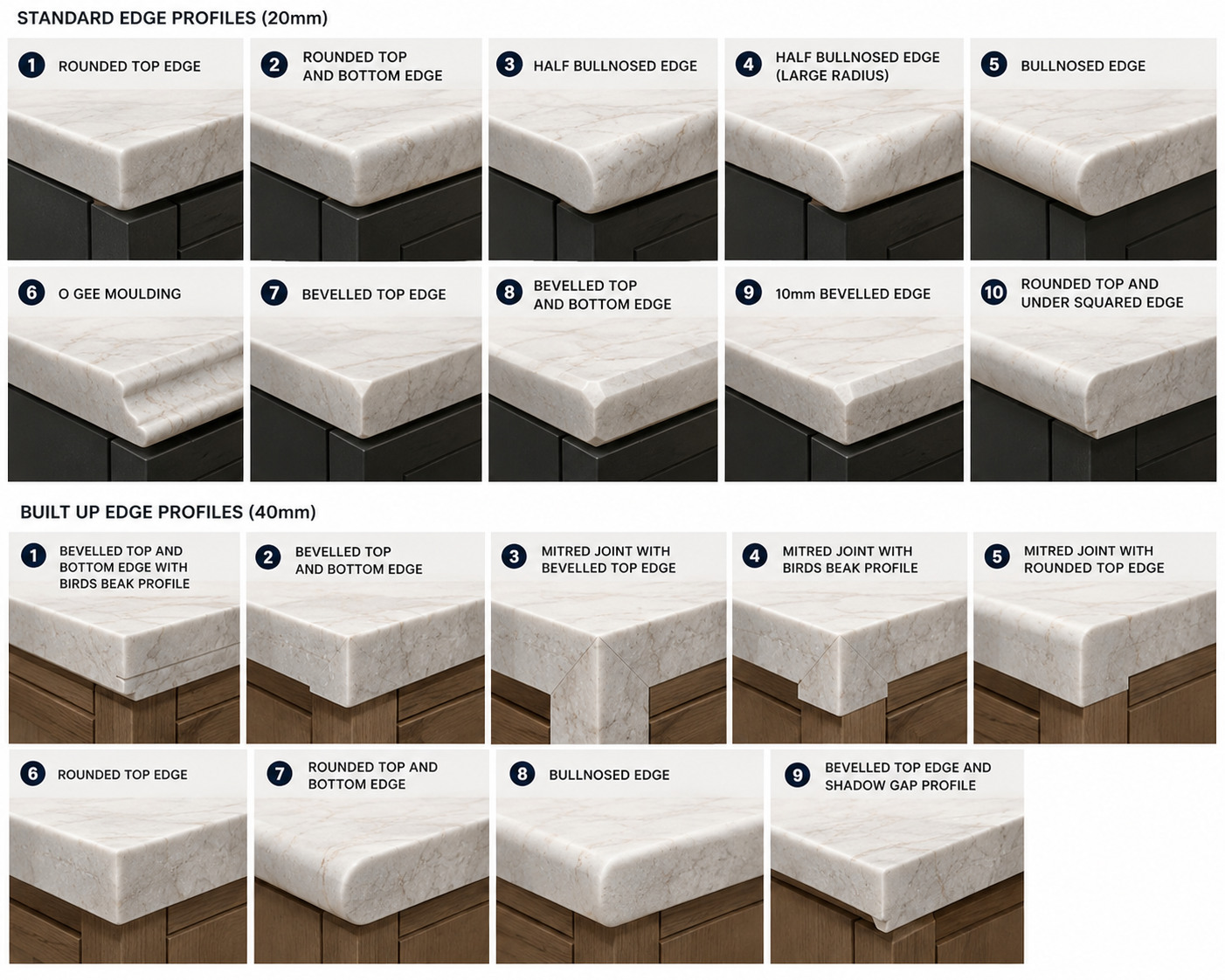 Comparison of common 20mm standard edge profiles and 40mm built-up edge profiles used in stone countertop fabrication.
What Is a Standard 20mm Stone Edge?
A standard edge is shaped directly from the original stone slab. When the slab is 20mm thick, the visible front edge remains close to 20mm after cutting, grinding and polishing. No additional stone strip is required beneath the countertop.
Common standard treatments include rounded, bevelled, half bullnose, full bullnose and ogee edges. A small radius or bevel mainly removes the sharp corner, while a bullnose or ogee requires more shaping and produces a softer or more decorative appearance.
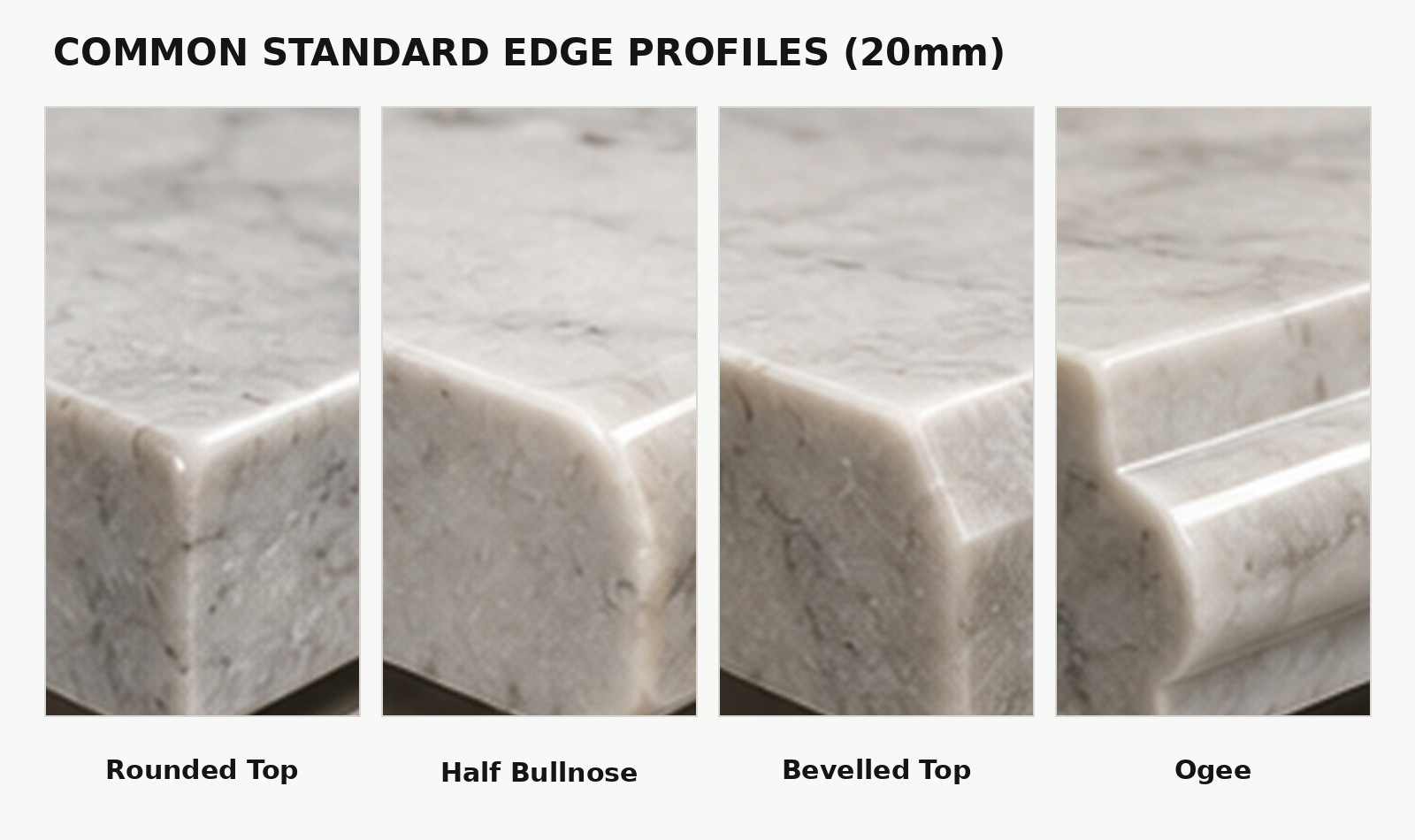 Typical 20mm profiles create different visual effects while retaining the original slab thickness.
Standard 20mm edges are commonly used for bathroom vanity tops, compact kitchen counters, window sills, shelves and contemporary stone furniture. Their construction is relatively simple, they require less additional material and they normally contain fewer visible joints.
How Is a 40mm Built-Up Edge Made?
A countertop that appears to have a 40mm edge is not always made from a solid 40mm-thick slab. In many projects, a thinner top slab is combined with an additional stone piece along the exposed front edge.
One method places a vertical return strip beneath the slab. Another method uses a mitred joint: the top and front pieces are cut at matching angles and joined at the corner. When the cutting, adhesive colour and polishing are carefully controlled, the edge can appear to be made from one thick block of stone.
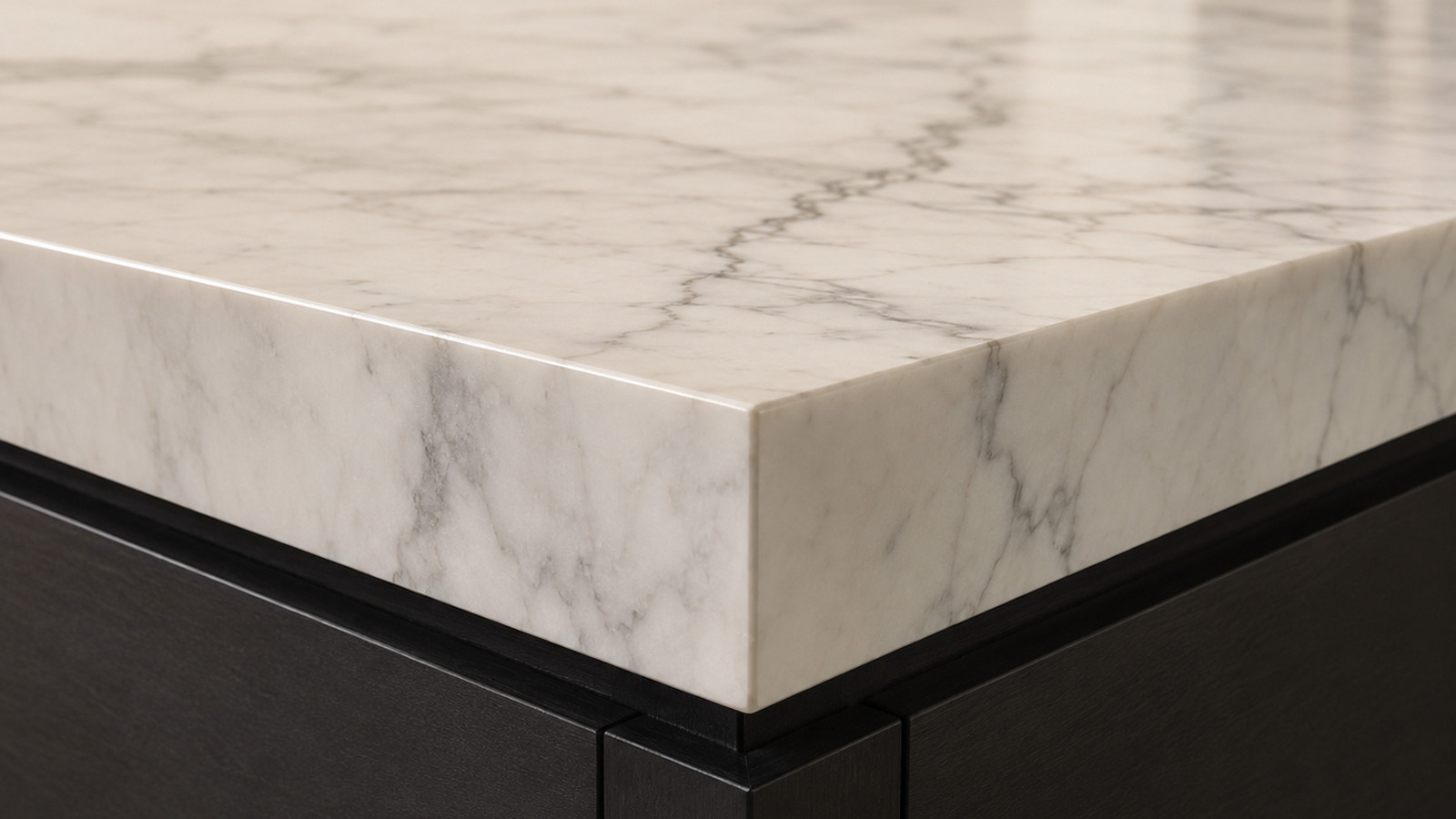 A mitred built-up edge allows a thinner slab to create the visual appearance of a thicker solid countertop.
Built-up edges are often selected for kitchen islands, bar counters, reception desks, large vanity tops and commercial counters. Their greater visual thickness helps a large stone surface feel better balanced with the base below.
Why Is Vein Alignment Important?
Vein alignment matters most when a built-up edge is fabricated from marble or quartzite with visible movement. If the return piece is cut without considering the direction of the pattern, the joint can interrupt the natural flow of the stone.
Careful selection and cutting can help the vein continue from the top surface onto the front edge. This is often described as vein matching or vein wrapping. The joint may still be detectable at close range, but accurate fabrication and a suitable adhesive colour can make it much less noticeable.
What Do R5, R10 and R20 Mean?
Technical edge drawings often include measurements such as R5, R10 or R20. The letter “R” refers to the radius of the curve, measured in millimetres.
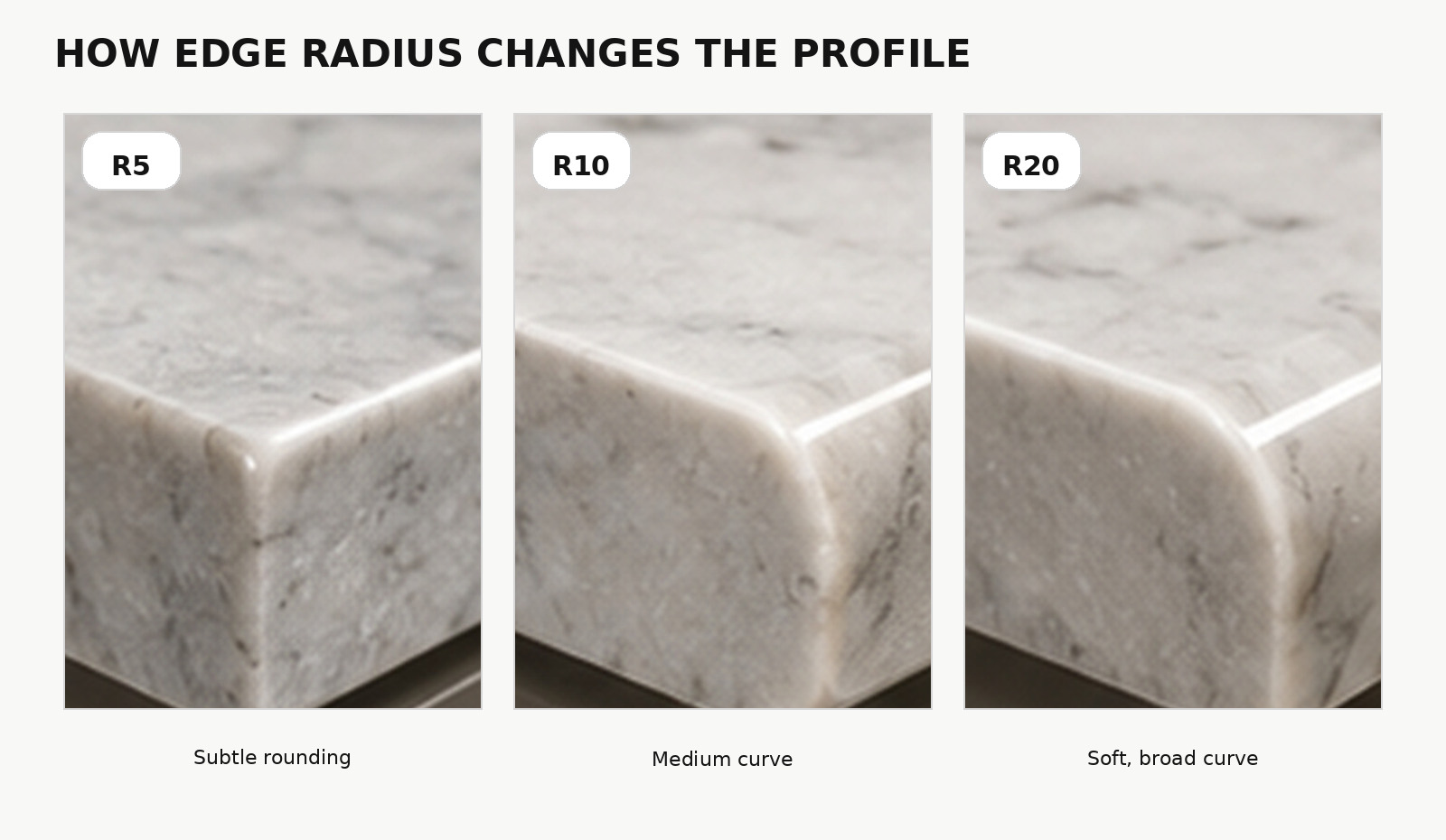 R5 keeps the corner relatively crisp, while R10 and R20 create progressively softer and broader curves.
A smaller radius mainly removes the sharp corner. A larger radius produces a deeper and softer curve, but it also removes more material. The selected radius must therefore be suitable for the slab thickness and the structural condition of the stone.
Rounded, Bevelled, Bullnose or Ogee?
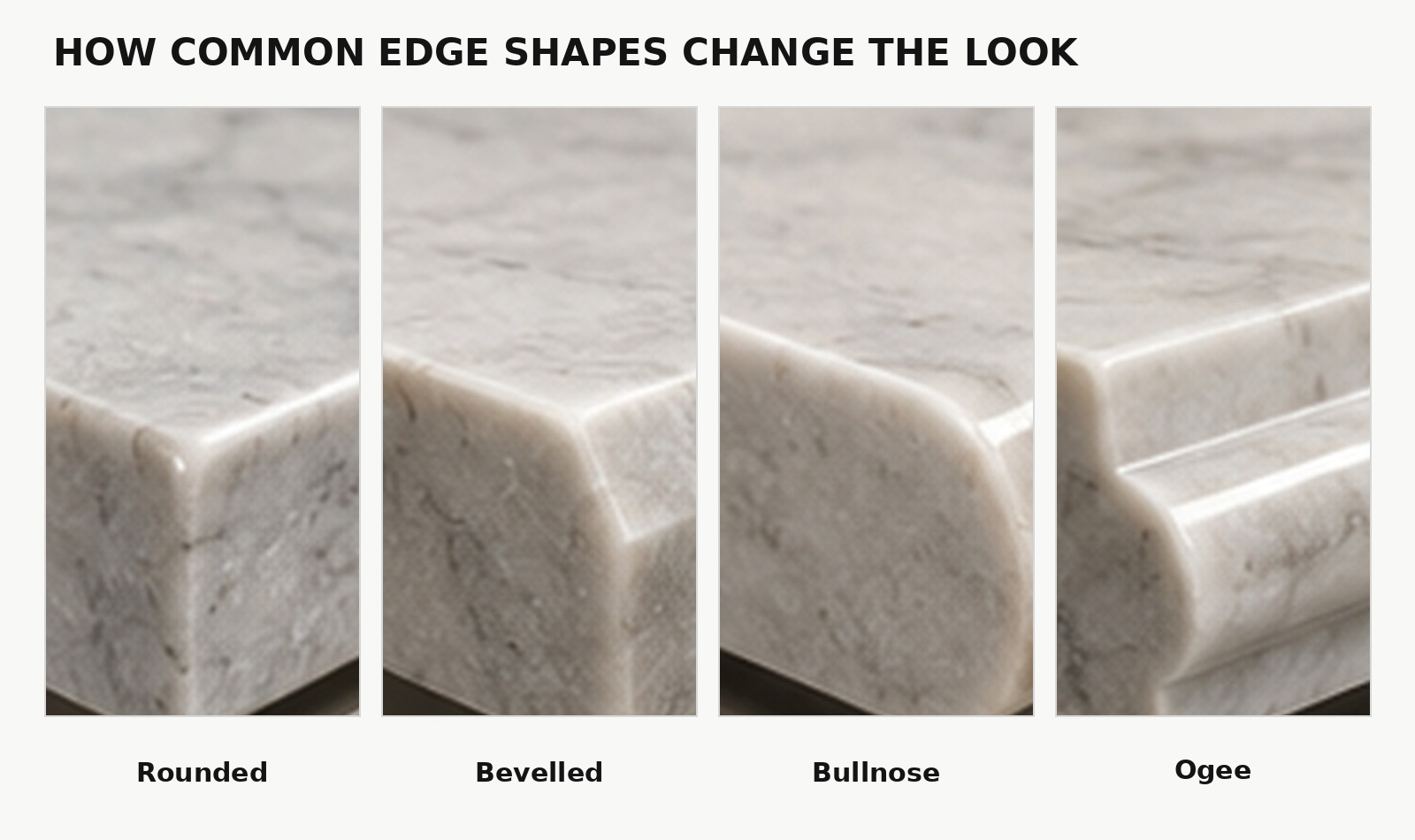 Different edge shapes can change the style of a countertop even when the stone material remains the same.
Rounded Edge
Softens the corner without making the countertop highly decorative. It works well in modern kitchens, vanity tops and frequently used areas.
Bevelled Edge
Creates a straight angled cut and a sharper architectural line. A small bevel is subtle, while a wider bevel becomes a stronger design feature.
Bullnose Edge
Forms a broad curve across part or all of the slab thickness. It produces a softer appearance and removes the exposed sharp corner.
Ogee Edge
Combines concave and convex curves. It is more decorative and is generally used where the countertop edge is intended to be visually prominent.
20mm or 40mm: Which Is More Suitable?
| Consideration | Standard 20mm Edge | Built-Up 40mm Edge |
|---|---|---|
| Visual effect | Slim, clean and lightweight | Thicker, stronger and more architectural |
| Construction | Shaped directly from the slab | Uses a return piece or mitred joint |
| Typical use | Vanities, compact counters, shelves | Islands, bars, reception and large counters |
| Joint visibility | Usually fewer edge joints | Fabrication quality and vein matching are important |
| Design character | Contemporary and understated | Substantial and visually prominent |
How Should the Right Edge Be Selected?
There is no single profile that suits every project. The decision should consider the interior style, countertop size, stone type, maintenance requirements and safety.
- Interior style: Rounded and bevelled edges generally suit modern spaces, while bullnose and ogee profiles create a softer or more decorative effect.
- Countertop scale: A slim edge may suit a small vanity, while a large island may look better with greater visual thickness.
- Stone condition: Open veins, fissures, large crystals or brittle areas may require reinforcement or a simpler profile.
- Maintenance: Simple profiles are usually easier to clean than deeply moulded decorative edges.
- Safety: A small radius or bevel reduces sharpness without dramatically changing the design.
The main difference between a standard 20mm edge and a built-up 40mm edge is not only thickness. A standard profile shows the original slab thickness and creates a cleaner, lighter appearance. A built-up profile uses additional fabrication to create a thicker and more substantial visual result.
Rounded, bevelled, bullnose, ogee and mitred details can all work well when they are selected according to the material, application and overall design. Before production, the finished thickness, radius, bevel dimensions, joint position and vein direction should be confirmed in an approved drawing.