 ×
×
NATURAL STONE / MATERIAL & APPLICATIONS Monica Red Marble From expressive slabs to bespoke kitchen islands, marble vanities, backsplashes and dining tables Monica Red marble polished slab — flowing burgundy, rose, cream and grey veini...
Share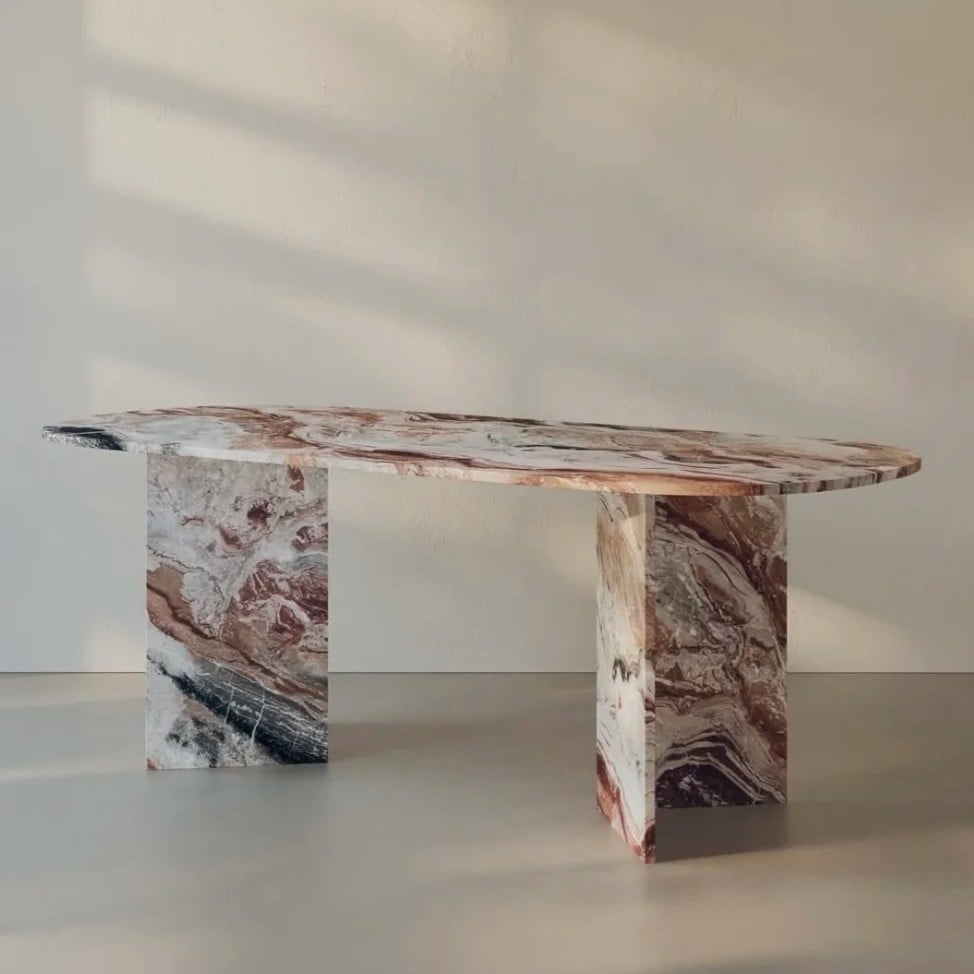
NATURAL STONE / MATERIAL & APPLICATIONS
From expressive slabs to bespoke kitchen islands, marble vanities, backsplashes and dining tables
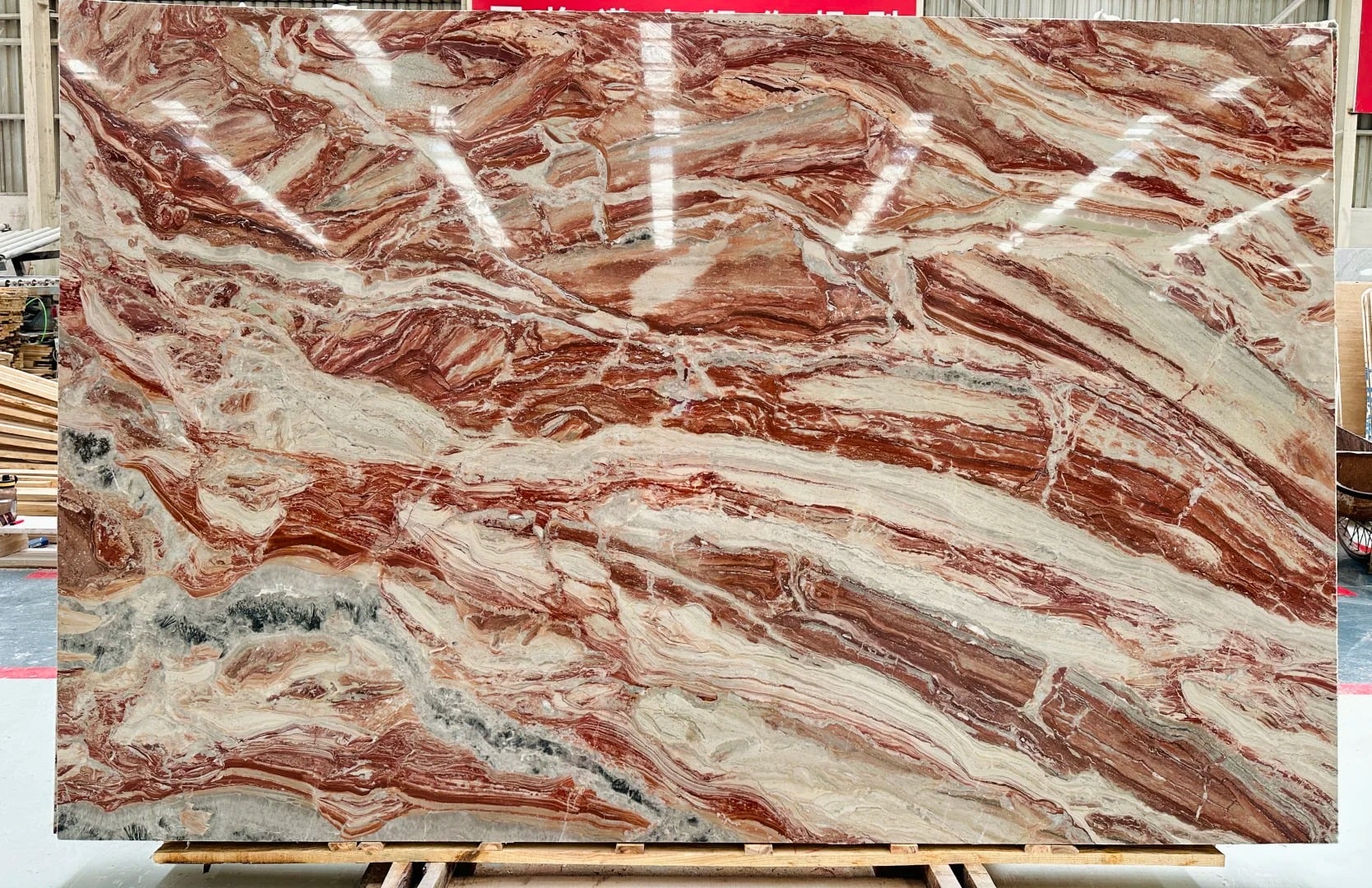 Monica Red marble polished slab — flowing burgundy, rose, cream and grey veining.
INTRO
Some marbles read as a single color from across a room. Monica Red marble is different. Its character comes from the way broad ribbons of wine red, rose, ivory and muted grey fold through one another. On a polished slab, these shifts can look almost like fabric that has been gathered and released. On a smaller object, they become a series of sharply drawn lines along an edge or curved profile.
That expressive pattern makes the stone particularly interesting for custom interiors. A kitchen backsplash becomes more than a protective surface; a stone table can carry the whole composition of a dining room; even the front face of a basin can become a focal point. The material works best when its movement is considered early, alongside the joinery, lighting and proportions of the space.
This case-led material study follows Monica Red marble from rough block and polished slab through four practical applications: backsplash panels, kitchen islands, vanity basins and dining tables. The photographs illustrate the range of effects possible with the stone. They are visual references rather than a single documented project supplied or installed by GOOD LUCK STONE.
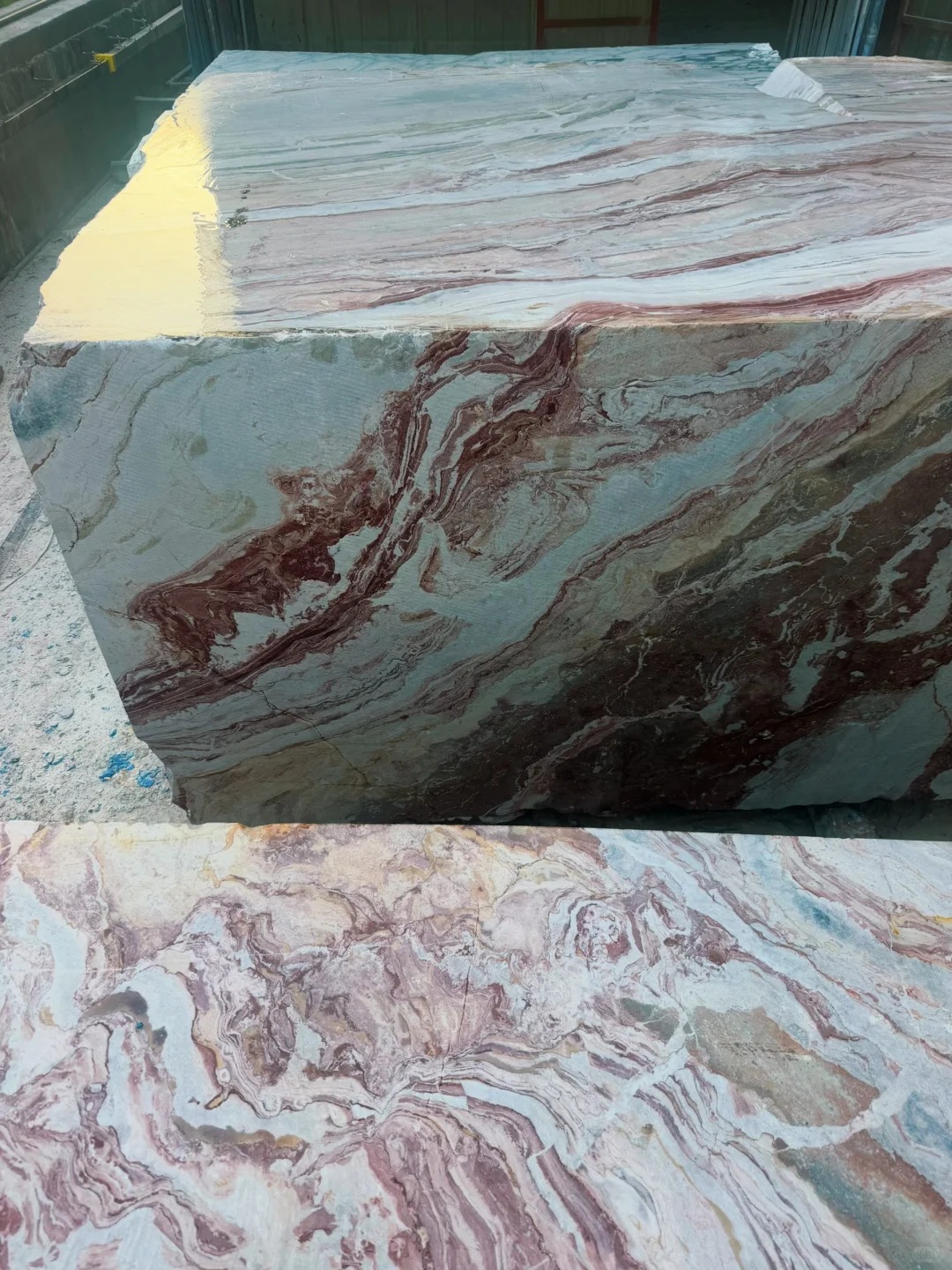 Rough stone block showing the layered red and pale mineral structure before cutting.
01 / THE MATERIAL
Monica Red marble is a decorative natural stone traded for its distinctive red-and-neutral, strongly layered appearance. Depending on the block and the cut, its background may read cream, pale grey, blush or warm beige, crossed by deeper burgundy and reddish-brown bands. Some areas have relatively calm, parallel veining; others show dramatic swirls, mineral patches and changes of direction.
Natural stone names are not always standardized between markets, and visually similar red-veined marbles may be offered under different trade names. That is why identification should be confirmed against the actual selected slabs and supplier documentation rather than the product name alone. For a project with a defined color scheme, photographs of the exact lot are more useful than a generic sample picture.
The large polished slab shown here makes the point clearly: one piece can contain quiet pale areas, tightly folded red bands and isolated darker markings. Rather than treating those variations as flaws, a designer can use them to decide where a focal feature should sit. A broad, richly figured section may suit an island top; a softer section can make an adjoining splashback easier to live with.
02 / FROM BLOCK TO SLAB
The first decision is not the finish or the edge detail. It is choosing the block and deciding how to open it. In the rough-block photographs, the mineral bands continue around adjacent faces, but the pattern on a sawn slab will change with the cutting orientation. Two blocks marketed under the same stone name may give quite different finished results.
For slab selection, ask to see every available piece laid out with visible slab numbers. Record length, width, thickness, finish and any resin treatment or mesh backing. For large-format wall cladding and worktops, mark the intended cutouts directly on a slab photograph before production. This helps protect the strongest sections of the pattern and keeps unwanted seams away from the main sightline.
Where the design calls for a continuous marble backsplash or waterfall edge, vein matching deserves specific attention. Bookmatching can create a symmetrical composition from sequential slabs, but it is only possible when the available material and sawing sequence support it. A flowing linear arrangement often looks more natural than a forced mirror image. The choice depends on the architecture and the selected stone, not on a preset rule.
As with many highly figured marbles, some veins or healed fissures may be present. These should be evaluated by the fabricator during inspection and cutting. Reinforcement, resin filling and the suitability of particular narrow sections need to be assessed individually, especially for long cantilevers, thin profiles and large sink openings.
03 / BACKSPLASH
A backsplash is one of the most effective places to use Monica Red marble because the vertical position allows the veining to be seen at eye level. In the dark interior reference, the marble is framed by nearly black cabinetry. Against that surrounding color, the pale mineral layers brighten the composition while the red bands repeat across the wall and adjacent horizontal surface.
A quieter approach appears in the timber kitchen reference. Here, warm wood cabinets sit beside the marble's burgundy and grey tones, making the space feel layered rather than heavily contrasted. The splashback does not have to fill the room. A single continuous panel behind a sink or preparation area can bring texture and a sense of crafted detail without competing with the cabinetry.
For a custom marble backsplash, the practical questions are straightforward: How tall is the protected area? Is it a full-height panel or a shorter upstand? Where are the sockets, taps, rails and open shelves? Can the finished slab be carried through the doors and installed safely? A cutting drawing should show all openings and seams, with the visible vein direction agreed before fabrication.
For daily use, stone behind a cooktop or sink should receive an appropriate sealer where recommended, and acidic spills should be wiped promptly. A polished surface offers strong visual depth but does not make natural marble impervious to etching. A honed alternative may give a softer reflection and make the movement feel more restrained; the maintenance and finish should be discussed with the client.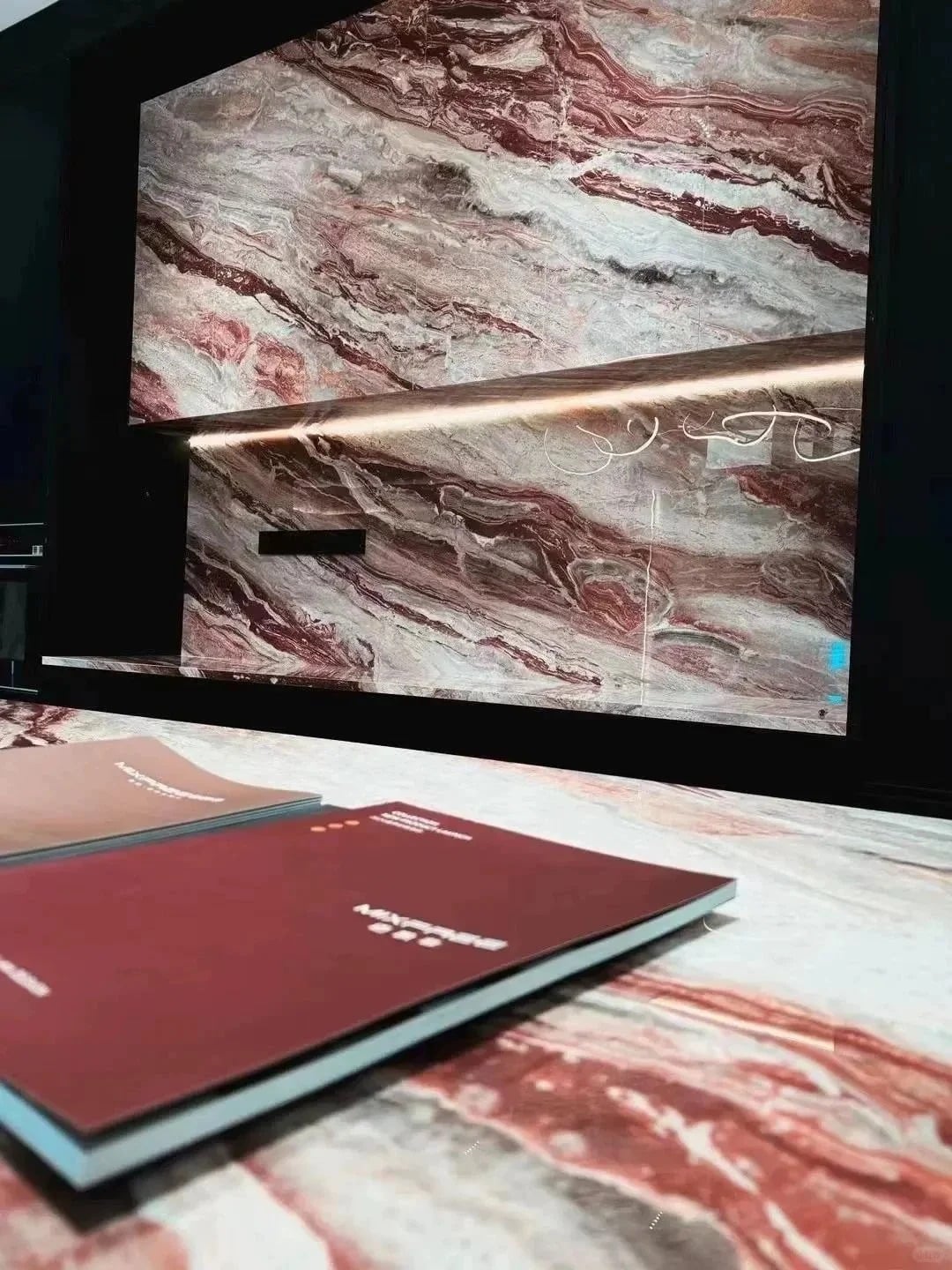
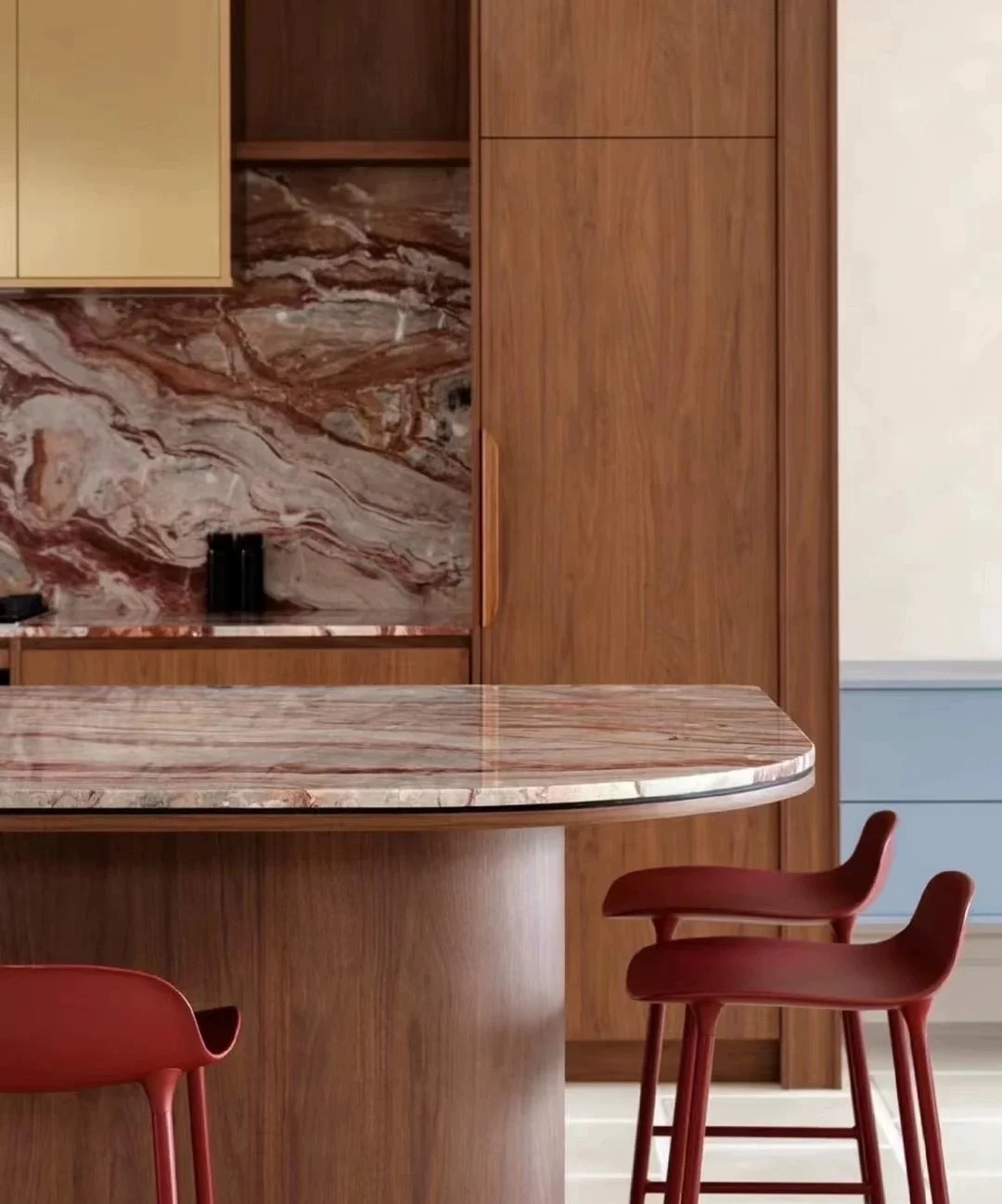 Monica Red-style red-veined marble backsplash paired with warm timber joinery.
04 / KITCHEN ISLAND
The kitchen island image shows a long Monica Red marble surface carried over a curved timber base and supported at one end by a cylindrical stone leg. The effect is achieved as much through geometry as through color: the smooth radius of the island and the circular support soften the strongly directional veining.
When specifying a Monica Red marble kitchen island, it helps to distinguish the structural base from the decorative stone skin. The support system, span, overhang and any appliance cutouts must be engineered for the actual dimensions. A seemingly solid marble leg may be designed as a fabricated cladding assembly rather than carved from one enormous block. This choice affects shipping weight, cost and installation method.
Edge design changes the appearance considerably. A simple eased edge keeps attention on the face of the slab; a laminated or mitered edge can create the impression of a thicker surface while controlling material use. For curved ends, templates, CNC cutting and careful hand finishing may be required, with the vein placement checked before the final cuts.
The island in the photograph is an example of how marble and timber can work together. The wood makes a large red-veined surface feel approachable, while small brass accents introduce warmth without pulling attention from the stone. Designers can achieve a different result with dark lacquer, bronze or pale painted joinery. The underlying principle is to give such a visually active material enough quiet space around it.
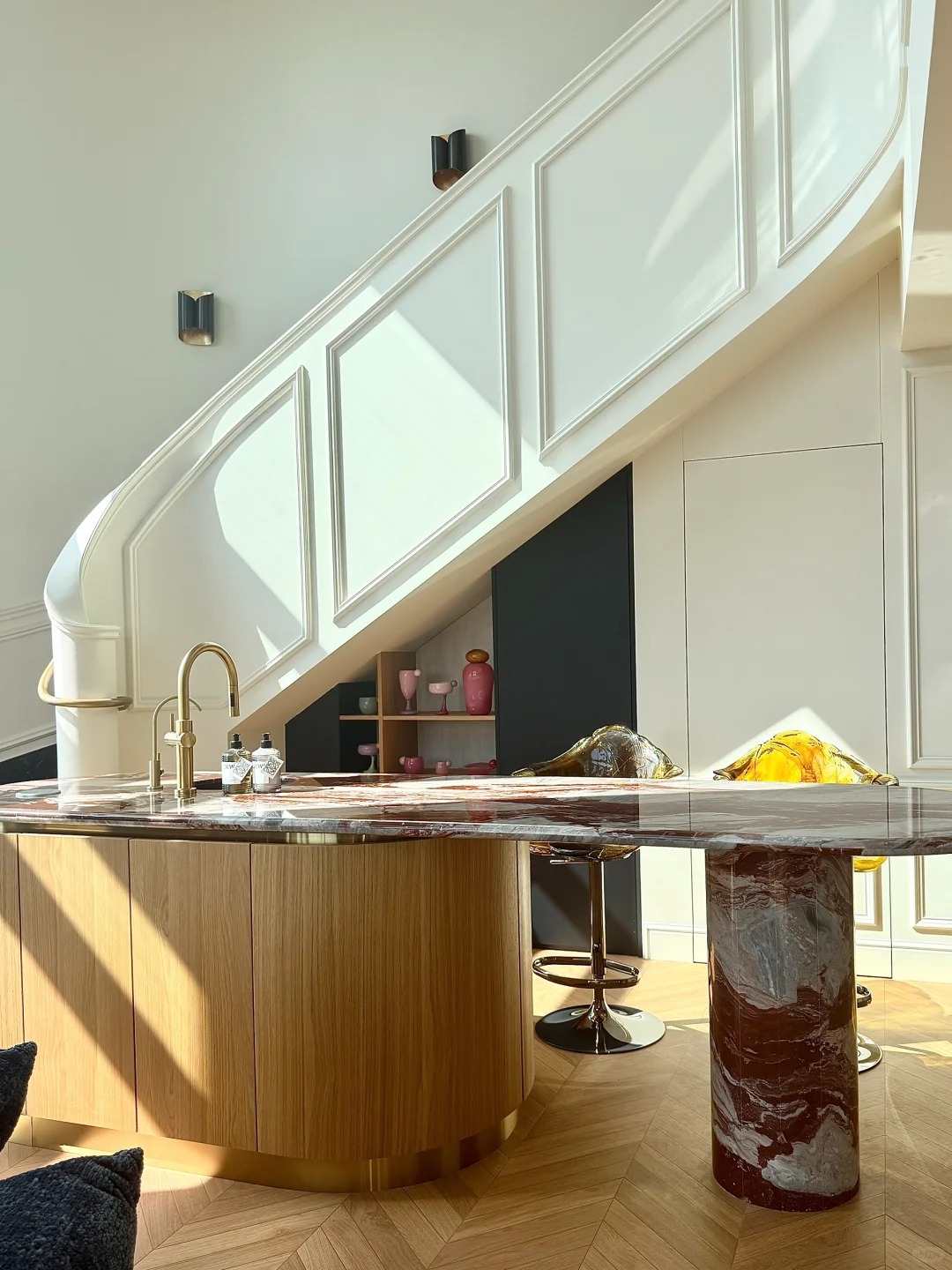 Custom kitchen island with a marble top and cylindrical marble-clad support.
05 / VANITY
In a bathroom or powder room, a Monica Red marble washbasin can feel like a small piece of architecture. The reference image shows a rectangular basin lined with the same expressive material on its base and internal walls. The cut edges reveal how the red-and-cream bands change direction from one plane to another, making the assembly interesting even before fittings are installed.
There are several fabrication routes for a custom marble sink. A basin can be built from accurately cut slabs with joined corners, or carved from a sufficiently suitable solid piece where size, material integrity and cost allow. Slab-built basins make better use of selected vein patterns and are often easier to plan around transport and weight limits. Whatever the method, the fabricator must check watertight detailing, corner joints, drainage fall, access for plumbing and the compatibility of sealants and adhesives.
Not every striking marble is equally suitable for every sink geometry. Deep recesses, delicate wall thicknesses and unsupported corners demand particular care. The desired appearance should be checked against the selected block's structure, and the basin assembly should be approved technically before cutting begins.
For bathroom use, a clear maintenance plan matters. Soap residues and standing water should not be left indefinitely; non-acidic stone cleaners are preferable to aggressive bathroom chemicals. Properly designed and maintained, a natural marble vanity can give a smaller room a distinctive identity without requiring full-height marble on every surface.
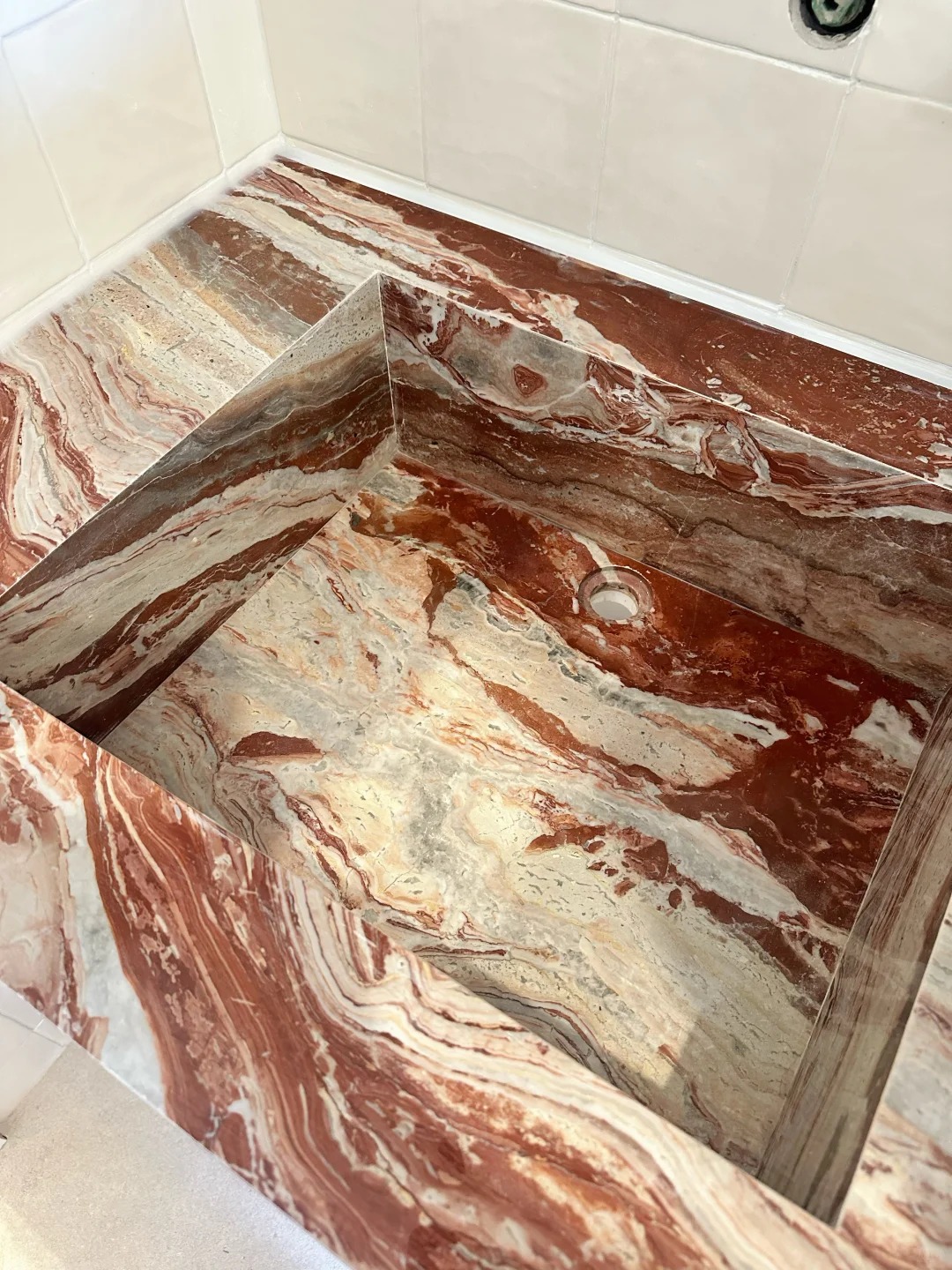 Fabricated marble washbasin / vanity with strongly figured internal and external surfaces.
06 / DINING TABLE
The dining table reference uses a rounded rectangular top with a broad spread of red, rose and cream veining. Against timber chairs and a simple wall, the tabletop becomes the strongest visual element in the space. The pattern is more organic than a printed decoration because every shift in color follows the actual stone.
For a custom Monica Red marble dining table, proportion is as important as the slab selection. Length, width, corner radius and edge thickness should be resolved together with the base design. Large tops require a stable support arrangement, attention to deflection, and appropriate handling provisions. A shaped edge can be particularly effective, but its radius should suit the stone and not leave fragile projections.
The top can be arranged to highlight a dramatic center section, or cut from a quieter part of a slab to allow chairs, pendant lights and surrounding finishes to share attention. There is no universally best layout. We recommend reviewing a digital cut plan over the actual slab photograph so the client can see precisely which part of the pattern will appear on the finished table.
Marble remains a natural calcium-carbonate material and can etch when exposed to acidic food and drink. Coasters, prompt spill removal and suitable cleaning products are sensible expectations for a dining surface. Clients seeking a completely maintenance-free table should understand these characteristics before approving the material.
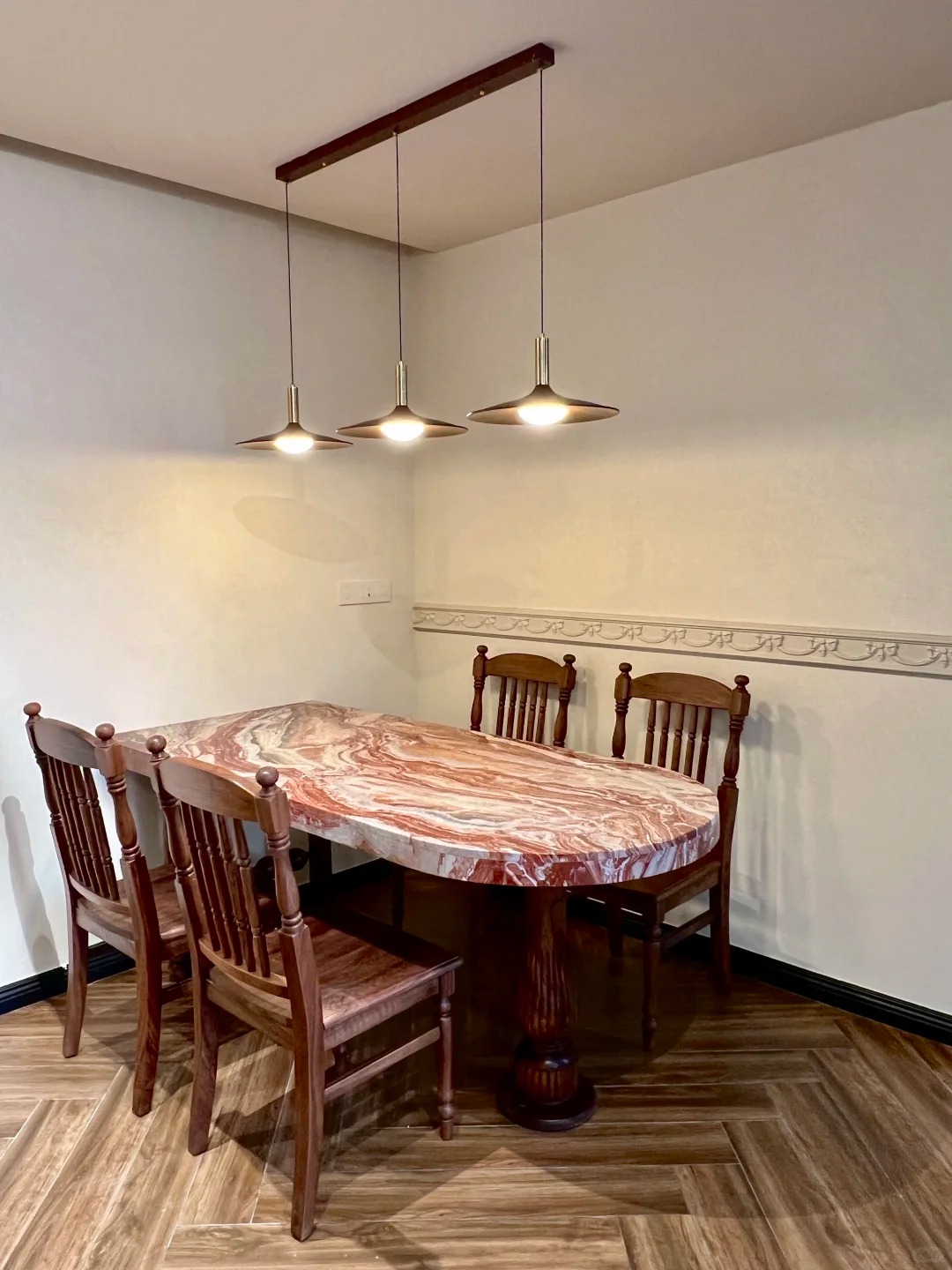 Rounded rectangular marble dining table with a distinctive natural vein composition.
07 / DETAILING
Polished Monica Red marble gives the veins depth and a strong reflection, particularly under controlled interior lighting. Honed finishing offers a more subdued result and can work well with soft timber, plaster and muted metalwork. Final availability depends on the slab and fabricator's finishing process; a physical finish sample should be approved if sheen is critical.
Thickness also depends on the application. Slabs may be offered in common nominal options such as 18–20 mm or approximately 30 mm, but those figures are not a confirmed specification for the photographed material. Cladding panels, table edges, basin walls and island supports may require different build-ups. The fabricator should propose the appropriate construction after reviewing the drawings, support and local installation conditions.
Details worth agreeing early include edge profiles, visible returns, corner miters, junctions with timber or metal, sink cutouts, tap positions, reinforcement, seam locations and any vein matching. For complex pieces, a workshop drawing is often more valuable than a verbal description. It allows the designer to assess the entire assembly before the saw starts.
08 / PROJECT PROCESS
GOOD LUCK STONE works with project buyers, designers and contractors on natural stone supply and made-to-measure stone fabrication. For Monica Red marble inquiries, our role is to help translate the intended application into material selection, cutting information and a clear quotation. That may include polished slabs, cut-to-size wall panels, marble backsplash pieces, island cladding, vanity components, countertops and table tops, subject to current material availability and feasibility review.
A useful request starts with the project location, drawings or dimensioned sketches, reference photographs, preferred finish, quantity and expected delivery schedule. For pieces where the veins are central to the design, we also recommend stating whether a continuous layout or bookmatched arrangement is preferred. We can then review available stone options, fabrication requirements and packaging needs for discussion.
Because marble varies from block to block, final color, veining and pricing should be confirmed from the actual available lot and agreed production drawings. Any lead time or structural solution should likewise be confirmed for the specific project rather than assumed from the images on this page.
CONCLUSION
Monica Red marble rewards projects that treat natural veining as part of the design, not simply a decorative finish. Its pale mineral layers keep the material versatile, while the red bands bring energy to kitchens, bathrooms and furniture. In a full-height backsplash, the pattern becomes architectural. On an island or dining table, it turns a working surface into a central feature. In a custom washbasin, smaller cut pieces can reveal unexpected details.
The most successful result starts with the right slab, a realistic understanding of marble's properties and careful decisions about every cut. If you are developing a Monica Red marble interior or looking for custom natural stone components, share your drawings and intended application with GOOD LUCK STONE. We can discuss suitable material options and the information needed to prepare a project-specific proposal.
CUSTOM NATURAL STONE / PROJECT ENQUIRIES
Send us your dimensions, application and reference images. We will review the stone selection and fabrication details with you.
CONTACT US FOR A CONSULTATION