 ×
×
NATURAL STONE / DESIGN CASE STUDY Vittara Crystal Quartzite: Bringing Natural Stone into Contemporary Architectural Spaces Exploring dramatic natural veining, sophisticated interiors, and custom architectural stone applications. ...
Share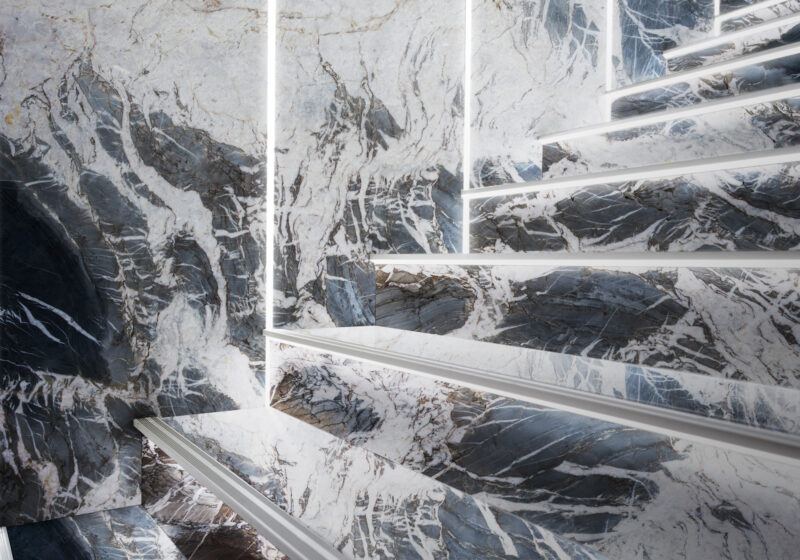
NATURAL STONE / DESIGN CASE STUDY
Exploring dramatic natural veining, sophisticated interiors, and custom architectural stone applications.
Natural stone has a remarkable ability to transform the atmosphere of an interior. A carefully selected slab can bring movement to an otherwise simple wall, add character to a kitchen, or turn a staircase into one of the most memorable features of a building.
Vittara Crystal Quartzite is a particularly striking example. Its appearance is defined by sweeping charcoal-grey formations, soft white areas, intricate mineral veins, and occasional warm undertones. Rather than following a predictable pattern, the colors intersect and flow naturally across the surface, creating a composition that feels almost like an abstract painting.
This distinctive character makes Vittara Crystal Quartzite an interesting choice for contemporary interiors where material expression plays an important role. Through the architectural applications featured here, we explore how this dramatic natural stone can be incorporated into reception spaces, kitchen countertops, custom staircases, and other interior design elements.
01 / MATERIAL CHARACTER
The first thing that draws attention to Vittara Crystal Quartzite is its extraordinary visual movement.
Broad areas of dark grey and charcoal appear alongside lighter crystalline formations, while fine white veins cross through the stone in irregular directions. In certain areas, subtle beige and brown mineral tones introduce additional warmth.
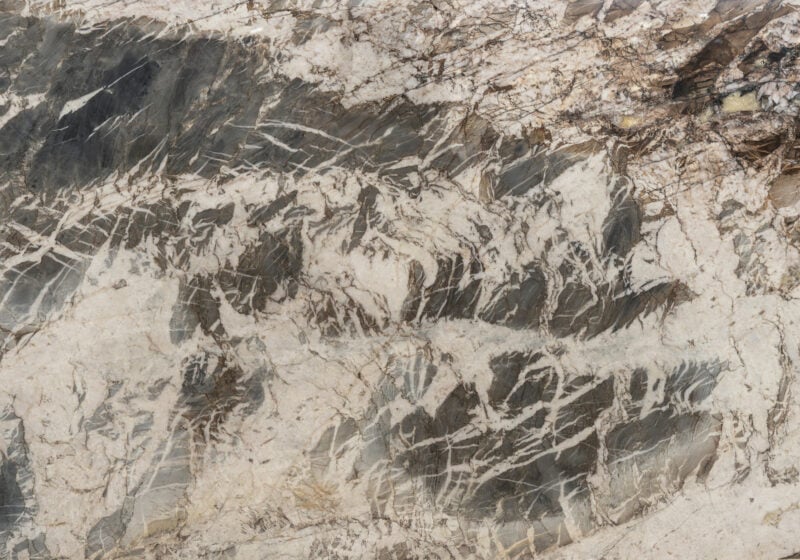
What makes the material especially interesting is that these contrasting elements do not appear evenly distributed. Some sections have a relatively quiet, pale background, while others contain dense, dramatic veining. This variation creates opportunities for different visual compositions, even when pieces are cut from the same slab.
Seen from a distance, the stone presents a powerful contrast between light and dark. Up close, its fine mineral lines and layered textures reveal a more intricate natural structure.
For architects and designers, selecting Vittara Crystal Quartzite is not simply a matter of choosing a grey-and-white stone. The position of individual veins, the orientation of panels, and the relationship between adjoining pieces can all influence the appearance of the finished installation. This is why viewing full slabs and planning the cutting layout are particularly important when working with strongly patterned natural stone.
02 / COMMERCIAL INTERIORS
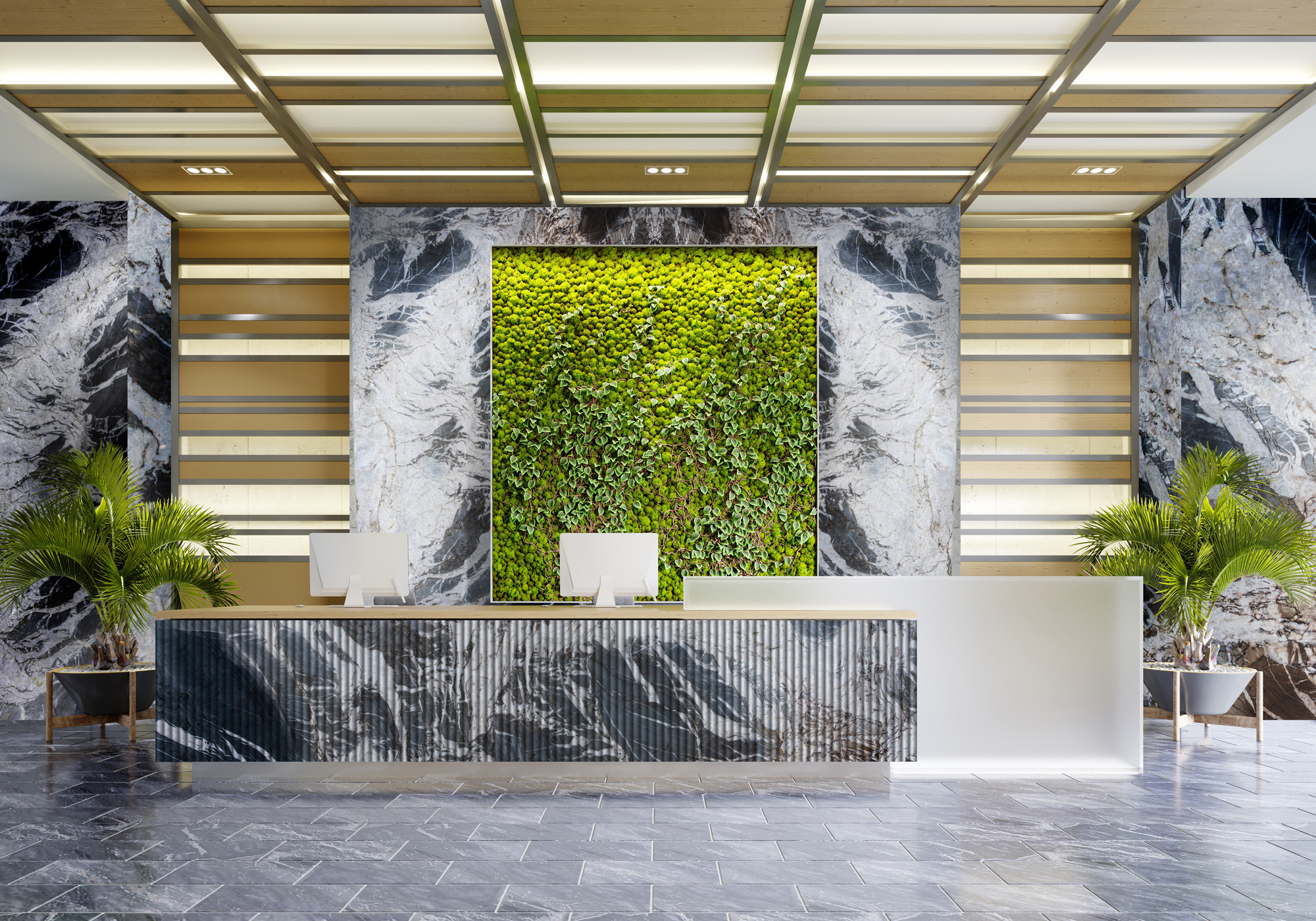
In the featured reception interior, natural stone becomes one of the defining elements of the entire space.
Large-format stone panels create a dramatic backdrop behind the reception desk. Their flowing grey, white, and charcoal patterns contrast with the precise horizontal and vertical lines of the surrounding architecture.
The ceiling introduces warm timber tones and illuminated rectangular panels, while the green planting wall provides a vivid natural accent. These different materials work together to create a space that feels contemporary without becoming cold or overly formal.
One particularly interesting detail is the reception counter. Its vertically textured stone front introduces a different surface treatment while maintaining the same overall material language as the surrounding wall panels. The combination of natural pattern and three-dimensional texture gives the counter a distinctive presence.
Instead of relying on elaborate decorative features, the design allows the stone itself to provide visual complexity.
This approach is especially effective in spaces where the first impression matters, including luxury hotels, corporate offices, private clubs, high-end retail environments, and residential entrance halls.
For projects involving large stone wall panels, the layout should be considered during the design stage. Panel dimensions, natural vein direction, visible joints, corner transitions, and lighting conditions can all influence the finished result. Careful planning helps preserve the architectural effect of the stone rather than allowing installation joints to interrupt its natural movement.
03 / KITCHEN DESIGN
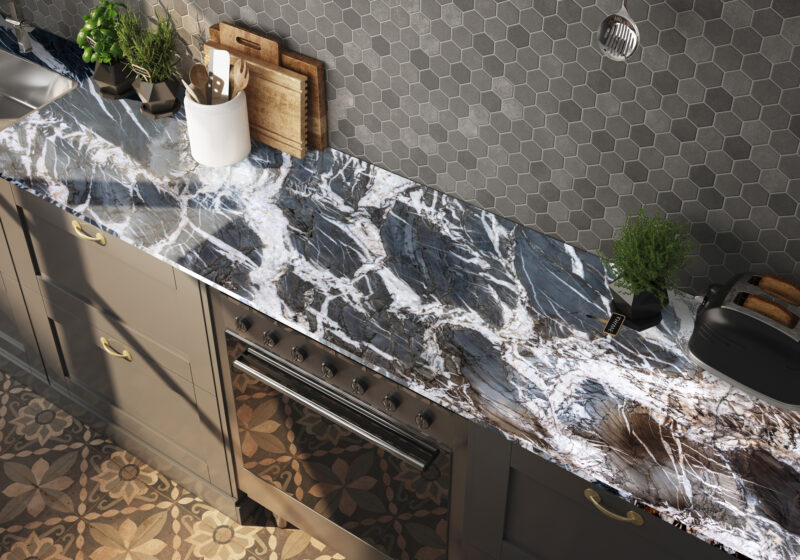
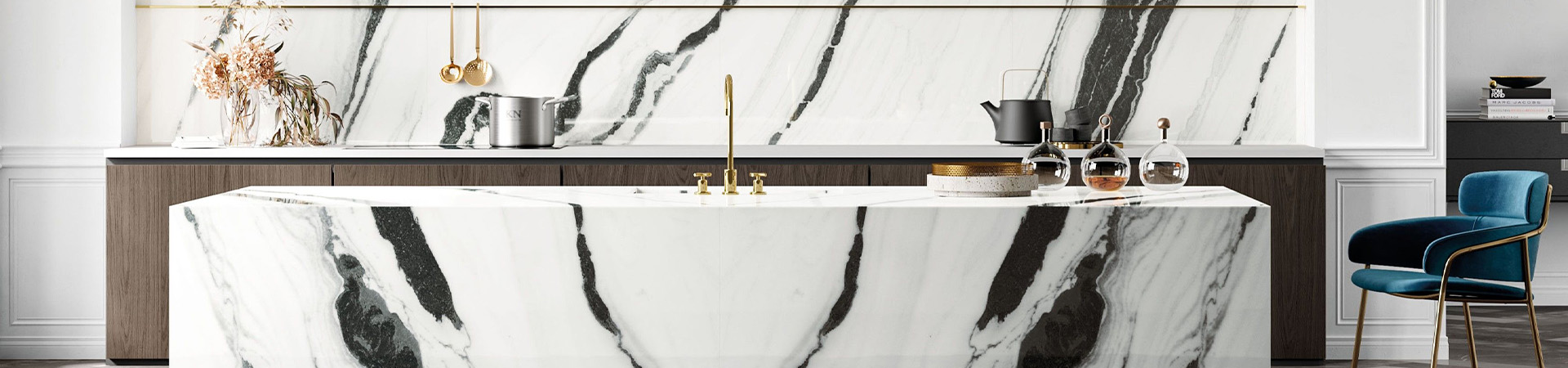
Vittara Crystal Quartzite creates a strong impression when used as a kitchen countertop. In the featured kitchen setting, the stone extends across a long work surface, displaying broad areas of grey and white veining against dark cabinetry.
The surrounding finishes have been kept relatively understated. Simple cabinet doors, discreet metal hardware, and a dark hexagonal tile backsplash provide a balanced backdrop for the expressive natural stone. The result is a kitchen that feels visually rich without requiring excessive decoration.
Unlike wall cladding, a countertop is primarily viewed from above and from relatively close distances. This makes the placement of the natural pattern particularly important.
The orientation of veins, the position of sink or appliance cutouts, and the transitions between adjoining stone sections can significantly affect the final composition. For larger kitchens, islands and adjoining countertops may also benefit from coordinated slab selection to create a consistent visual character throughout the room.
From a fabrication perspective, custom natural stone countertops require accurate measurements, appropriate edge profiles, precise openings, and careful consideration of support conditions.
Quartzite is commonly considered for kitchen surfaces because of its hardness, although actual stain resistance, maintenance requirements, and performance depend on the specific stone and finish. Material suitability should always be confirmed before fabrication. When thoughtfully selected and detailed, Vittara Crystal Quartzite can provide a countertop with both architectural impact and a distinctive natural identity.
04 / CUSTOM STAIRCASES
A staircase is often treated as a practical connection between floors. However, when natural stone is incorporated into its design, it can become a major architectural feature.
The staircase shown here demonstrates the visual possibilities of using heavily veined stone across multiple adjoining surfaces. The dramatic grey-and-white patterns extend across the stair treads, risers, and surrounding wall panels, creating a sense of continuity.
At the same time, integrated linear lighting emphasizes the geometry of each step. The contrast between the organic stone patterns and the clean illuminated edges produces an interesting balance between natural material and contemporary architectural detailing.
Unlike a simple wall installation, a stone staircase must accommodate several intersecting surfaces and precise dimensional requirements.
The relationship between the treads and risers is particularly important. Edge profiles, stone thickness, structural support, and installation tolerances need to be coordinated with the overall stair design. Where concealed LED lighting is included, the locations of lighting profiles, recesses, and edge details should be considered before stone cutting begins.
Natural vein orientation can also influence the finished appearance. Depending on the available slab patterns and project requirements, individual pieces can be arranged to create either visual continuity or deliberate contrast.
For practical use, the appropriate surface finish and slip resistance must be evaluated according to the installation environment. With careful design and fabrication, natural stone can transform an ordinary staircase into a sculptural element that connects different levels of an interior.
05 / STONE SELECTION & FABRICATION
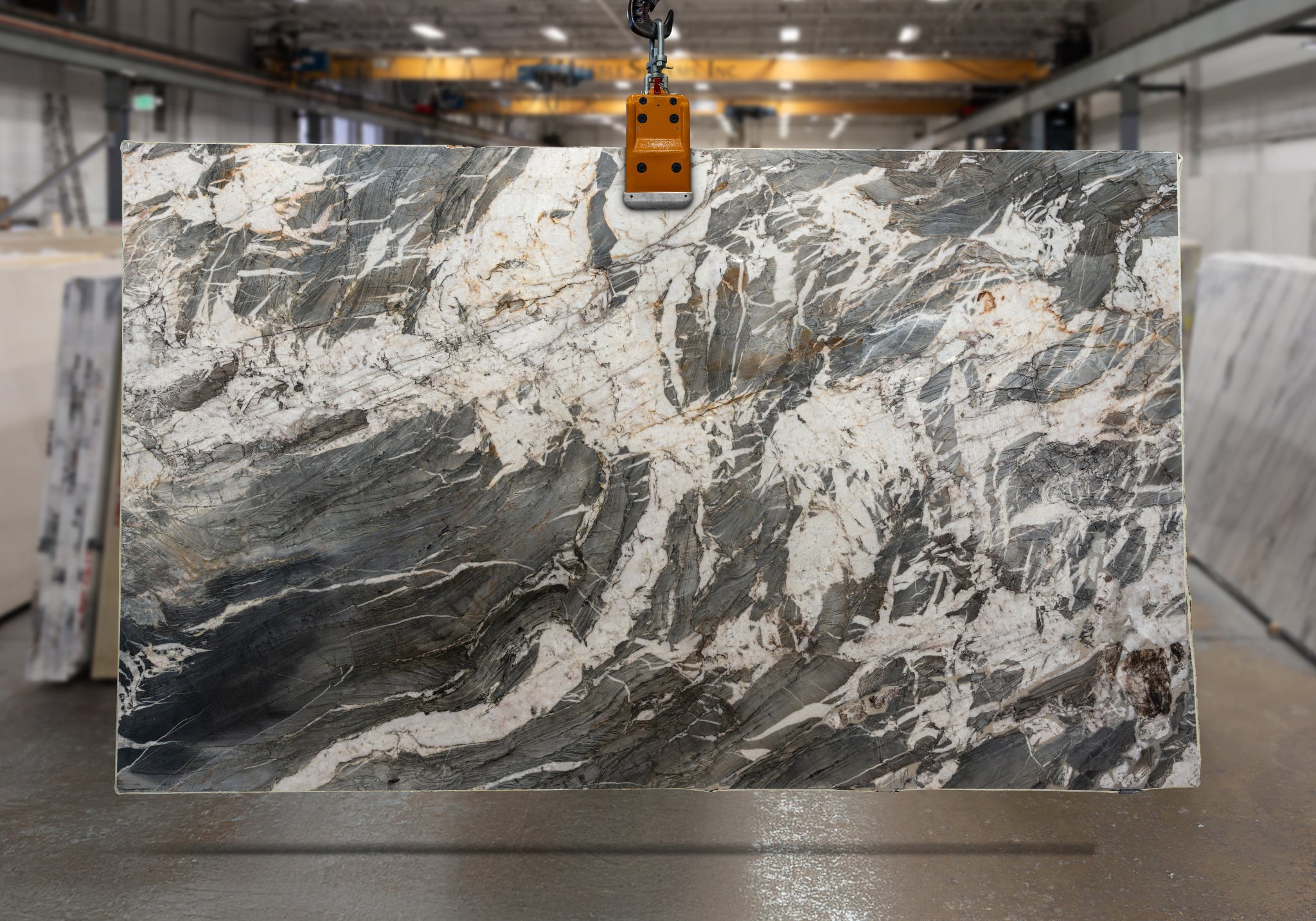
Behind every successful natural stone application is an important process that often receives less attention than the finished design: slab selection and cutting layout.
The full slab of Vittara Crystal Quartzite reveals how dramatically its natural pattern can vary across a single surface. Large charcoal-grey areas flow through irregular white mineral formations, while smaller veins extend in different directions across the stone.
This variation is precisely what gives natural stone its individual character. However, it also means that two pieces cut from different positions on the same slab may have noticeably different appearances.
For a kitchen countertop, the aim might be to position a particularly expressive vein across the main working surface. For a feature wall, the cutting layout may focus on how adjoining panels relate visually. For a staircase, the priorities may include tread dimensions, vein direction, edge detailing, and the relationship between horizontal and vertical surfaces.
There is no single layout that works for every project.
Successful natural stone fabrication begins with an understanding of the intended architectural application, including surface dimensions, vein orientation, and installation details.
Depending on the design and specification, custom stone fabrication may include:
Depending on the project, slab photographs, cutting drawings, dimensional requirements, and finishing details can be reviewed before production. This coordination helps translate the designer's material vision into accurately fabricated stone components.
06 / DESIGN PERSPECTIVE
One of the most important considerations when working with an expressive material like Vittara Crystal Quartzite is understanding how it interacts with the surrounding space.
Because the stone already contains strong natural movement, it often works particularly well alongside simpler architectural finishes.
Warm timber can soften the contrast of the grey and white mineral patterns. Dark cabinetry and metal accents can reinforce a contemporary aesthetic. Neutral plaster walls and understated lighting can allow the natural stone to become the main visual feature.
The proportions of the application are equally important. A large feature wall creates an immersive visual statement, while a carefully positioned countertop or staircase introduces the same material character on a more controlled scale.
Rather than applying natural stone everywhere, the most successful designs often establish a clear relationship between the material and the architecture. In this way, Vittara Crystal Quartzite becomes more than a decorative surface. It becomes part of the visual identity of the space.
CUSTOM NATURAL STONE SOLUTIONS
Every natural stone project begins with an idea, but the final result depends on thoughtful material selection, precise fabrication, and attention to architectural details.
Vittara Crystal Quartzite demonstrates how a distinctive natural stone can take on different roles across contemporary interiors, from dramatic reception walls to tailored kitchen countertops and architectural staircases.
From full slab selection to cut-to-size architectural components, a well-coordinated fabrication process helps translate design concepts into practical stone specifications.
For residential, hospitality, or commercial applications, project-specific considerations may include material availability, dimensions, finish options, technical suitability, and installation requirements.
CONTACT US FOR A CONSULTATIONNatural stone varies in color, pattern, and mineral composition. Images illustrate the material's visual characteristics and design possibilities. Actual slab availability and technical suitability should be confirmed before ordering.